What actually makes a beach the best in Puerto Rico? If you asked the roughly 500,000 people who pass through Balneario de Carolina in a typical year, most would point to something practical: a lifeguard stand they can see from any towel spot, a shower that works, a parking lot that isn't a gamble. None of them would mention water chemistry. And that's the detail that gets lost every time this beach shows up in a headline.
For the second year in a row, Balneario de Carolina took first place in USA TODAY's 10Best Readers' Choice Awards for 2026, a national reader-vote ranking of the country's best beaches. The Isla Verde coastline, also within Carolina's municipal limits, landed second in the same list. Playa Flamenco in Culebra came in third, and Balneario La Monserrate in Luquillo took fourth, according to reporting from WIPR. Two of the island's top four beaches, first and second place, both belong to the same town. That's not a coincidence residents should shrug off. But it's also not the whole story.
Two Rankings, Same Sand, Different Questions
Here's the island's top four for 2026, as confirmed by El Nuevo Día:
- Balneario de Carolina
- Isla Verde coastline
- Playa Flamenco, Culebra
- Balneario La Monserrate, Luquillo
A reader-choice award like this one is a popularity contest with structure. Voters aren't submitting water samples. They're rating what they experienced: whether they felt safe, whether the place was clean when they arrived, whether their kid had something to do besides sit in the sand. The infrastructure spending started with a $1.5 million total reconstruction of the balneario after Hurricane María damaged it in 2017, followed by years of continued maintenance investment since. That reconstruction and maintenance history is part of the balneario's story, but it's an infrastructure story, not a water-quality measure.
A beach can win the popularity vote on staffing, safety, and amenities alone. Water quality is a separate certification, measured by a separate program, on a separate timeline.
That distinction matters more than it sounds like it should, and it's the part most coverage of this story skips entirely.
What $1.5 Million and a Pirate Ship Actually Bought
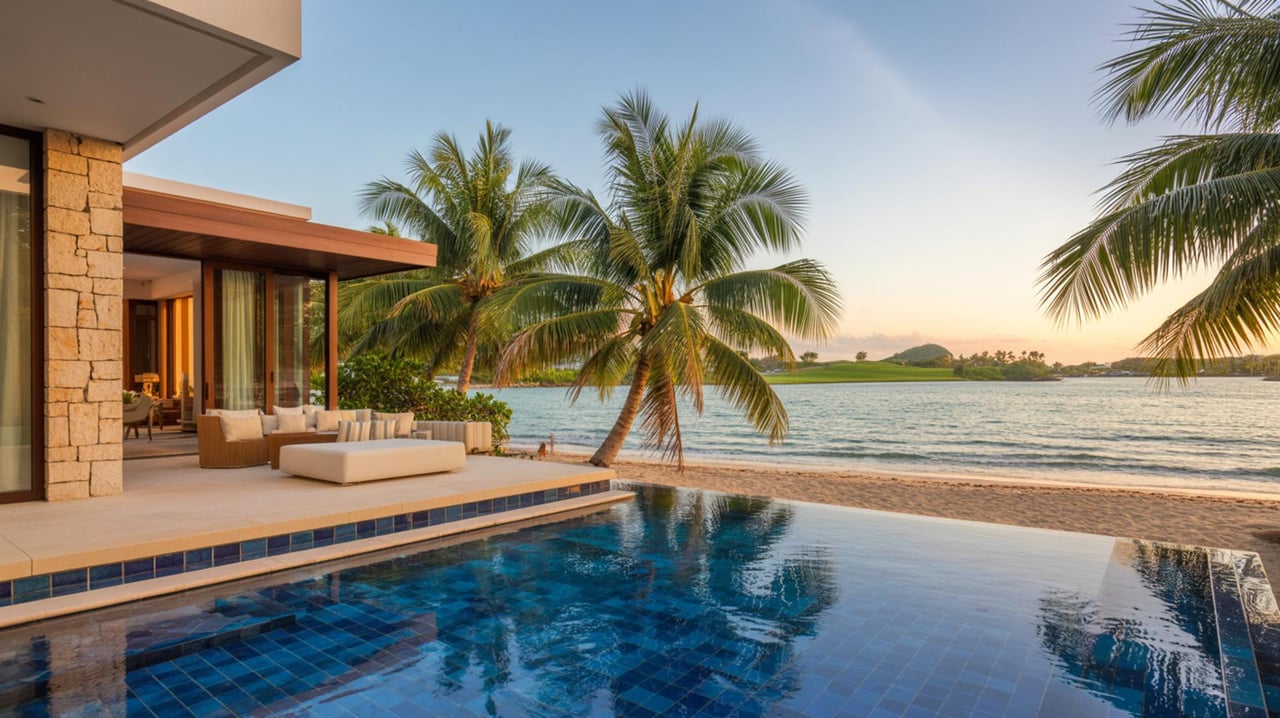
Walk the property today and the investment is visible in specifics, not vague upgrades. The balneario runs on certified lifeguards, a permanent on-site ambulance with paramedics, and regular patrols from the Municipal Maritime Police unit, on top of continuous water-quality monitoring. There are showers, accessible restrooms, gazebo rentals, beach volleyball and beach tennis courts, and a bike path running the length of the property.
For families, the standout is Aquasol, the municipal children's water park built into the balneario grounds. It's not a generic splash pad. It has multiple slide levels, a pirate-ship structure fitted with water cannons, and a tower that dumps a burst of water when an alarm sounds, a detail kids clearly remember because it shows up in almost every visitor description of the place. The park runs on a shift system, capped at roughly 200 people at a time, so a Saturday afternoon crowd doesn't turn into an unsafe crush.
On the food side, two names come up repeatedly among regulars: BambooBei Beach Bistro and Vaivén Beach Bar, both operating right on the property so a beach day doesn't require leaving to eat. The municipality has also built a formal program around all of this, the Carolina Tropical Beach Experience, aimed at cruise groups, hotel guests without their own beach access, and corporate outings, essentially packaging the balneario's amenities for visitors who'd otherwise never find them.
None of that is a coincidence. It's what $1.5 million in post-María reconstruction, plus years of follow-on maintenance spending the mayor has publicly committed to continuing, actually buys: a beach engineered around the experience layer that a reader's-choice vote rewards.
The Certificate That Doesn't Always Follow the Trophy
Here's where it gets more interesting than the press release. Blue Flag is a separate international certification tied to water quality and environmental management, awarded on its own annual cycle, independent of any tourism popularity contest. Balneario de Carolina has carried that certification in past seasons. But beach guides that track Blue Flag status specifically, separate from tourism rankings, have noted stretches where the balneario held the reader's-choice crown without simultaneously holding that particular certification in the same season.
That's not a scandal. It's a reminder that these two systems are measuring two different things, on two different clocks, and conflating them is exactly the mistake a rushed headline makes. The USA TODAY vote rewards the visitor experience: safety, staffing, cleanliness as perceived on arrival, family amenities, accessibility. Blue Flag audits a narrower environmental standard tied to water testing and site management practices. A beach can excel at one without holding the other in any given cycle, and neither outcome cancels the other out.
For residents, this is worth knowing precisely because it cuts against the version of the story that gets repeated without any digging: "our beach won an award, therefore the water is certified clean this year." Those are two separate claims, and only one of them is what the USA TODAY vote actually measured.
Reading the Calendar Instead of the Trophy
If you already live near the balneario, the more useful information isn't the ranking, it's the operating rhythm. High season runs May 15 through August 15, when the beach opens daily from 8 a.m. to 6 p.m. Outside that window, hours shift to Tuesday through Sunday, 8 a.m. to 5 p.m., with the balneario closed Mondays unless a holiday falls on one. Visitor volume concentrates heavily in that March-through-August stretch, which means a Tuesday morning in October looks nothing like a Saturday in July, even though it's the same beach that just won a national award.
That gap between the award season and the actual calendar is the kind of thing a visitor guide won't tell you but a neighbor will. If the goal is Aquasol without a wait, or a gazebo without a reservation scramble, the off-peak weekday afternoons are still wide open, award or no award.
What the Win Actually Confirms
Carolina holding both first and second place on the same national list isn't a fluke of good sand. It's the compounding effect of a municipality that rebuilt a damaged public beach with real money, staffed it properly, and kept reinvesting instead of treating the reconstruction as a one-time fix. The reader's-choice trophy is proof that strategy worked, on the terms that award actually measures. Whether the Blue Flag lines up in any given year is a separate scoreboard, tracked by a separate body, on its own schedule, and residents who understand that distinction are better informed than the headline that ran the week the award was announced.
That's the kind of detail worth knowing about the place you already call home, not because it changes your weekend plans, but because it's the difference between repeating a press release and actually understanding your own neighborhood.
For more on what's happening across Carolina, San Juan, Guaynabo, and Dorado, from the market fundamentals to the day-to-day texture of these neighborhoods, Mi Corredor keeps a closer eye on this corner of the island than most. If you're thinking about property here, whether buying, selling, or just curious what your home might be worth, Call Javi.